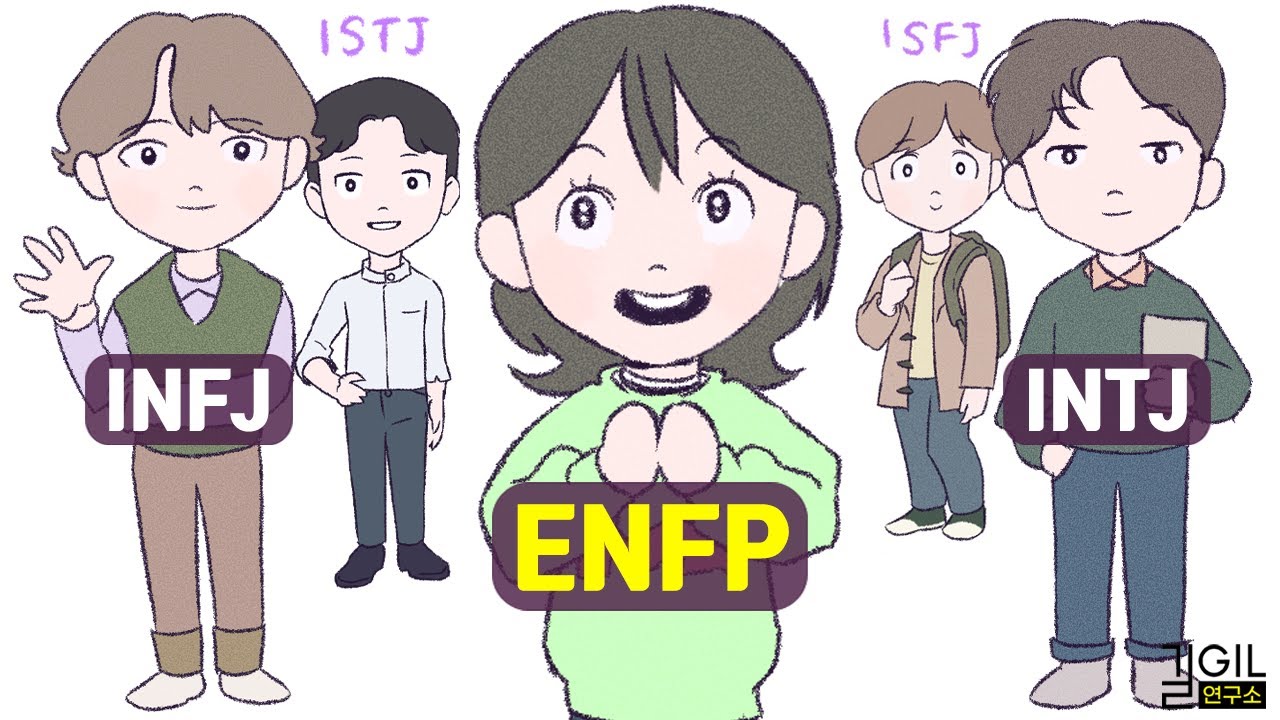
INTJ
🎬 Watch videosToday's Videos
News





🧩 Features
At a Glance
INTJ stands for Introverted (I), Intuitive (N), Thinking (T), and Judging (J). On 16Personalities, they are dubbed "The Architect," while the Korean edition translates this as the "Careful Strategist." Across Korean online communities, INTJs often get tagged with memes like "human robot" or "the type plotting world domination alone in their room." In reality, it is not that they lack emotions—they simply rarely put them on display.
| Trait | Overview |
|---|---|
| Archetype | The Architect (Careful Strategist) |
| Cognitive Functions | Ni (Introverted Intuition) – Te (Extraverted Thinking) – Fi (Introverted Feeling) – Se (Extraverted Sensing) |
| Key Traits | Strategy, independence, long-term vision, efficiency, perfectionism |
| Strengths | Big-picture insight, actionable logic, self-driven initiative, laser-sharp focus |
| Weaknesses | Struggles with emotional expression, can appear arrogant, overly critical, perfectionist burnout |
| Rarity | Approx. 2.1% of the general population based on The Myers-Briggs Company's US sample — 3.3% of men, 0.8% of women |
| Commonly Confused Types | INTP · INFJ · ENTJ · ISTJ |
Understanding INTJ Through Cognitive Functions
Behind their notoriously "chilly" first impression lies a remarkably structured mental operating system.
Dominant: Ni (Introverted Intuition) — Distills scattered data into a single, cohesive breakthrough. Rather than getting caught up in the immediate situation, INTJs instinctively ask, "Where is this all heading?" and calculate several moves ahead. This explains their strong preference for a predictable master plan over spontaneous improvisation.
Auxiliary: Te (Extraverted Thinking) — Turns that visionary insight into real-world execution. Once a clear goal is set, they strip away all fluff to map out the most efficient route. When someone vents, an INTJ's immediate impulse to offer a practical fix rather than gentle comfort is driven directly by their Te.
Tertiary: Fi (Introverted Feeling) — An internal, unvoiced moral compass. Even when they appear completely detached, INTJs hold firm lines about right and wrong. However, because this function is less developed, they often feel awkward putting their deepest emotions into words.
Inferior: Se (Extraverted Sensing) — Grounding in the present physical moment and spontaneous action. Being their weakest spot, this function tends to flare up unpredictably under intense pressure (see the stress section below).
In short, INTJs excel at piercing through complex problems and building robust systems to achieve long-range goals, but they struggle with navigating human emotional nuances. Because they deliver unvarnished truths without sugarcoating or quietly look down on substandard work, they easily get labeled as "arrogant."
INTJ-A vs. INTJ-T: What's the Difference?
The "-A" and "-T" suffixes are not part of the traditional Myers-Briggs framework. They represent the "Identity" dimension introduced by 16Personalities, measuring how much confidence individuals place in their own abilities and decisions.
| Dimension | INTJ-A (Assertive) | INTJ-T (Turbulent) |
|---|---|---|
| Core Attitude | Confident in decisions, emotionally steady | Constantly self-monitoring, sensitive to stress |
| Handling Mistakes | Moves on quickly with "Here's how to fix it next time" | Ruminates on the root cause, builds fail-safes against repetition |
| External Criticism | Rarely shaken by others' opinions | May look unfazed on the outside, but stews on it internally |
| Perfectionism | Willing to compromise on process as long as the end goal is met | Prone to exhaustion trying to optimize every micro-detail |
| Popular Image | Closest to the "cold-blooded strategist" meme | The "staying up all night overthinking the plan" INTJ |
According to 16Personalities, Assertive (-A) types tend to be self-assured, calm, and resilient against stress, whereas Turbulent (-T) types are more self-conscious and stress-sensitive, but driven by a relentless desire for achievement and self-improvement. This is why two INTJs can project noticeably different vibes. Keep in mind that this metric exists solely within the 16Personalities test and will not appear on an official MBTI report.
How INTJ Handles Stress
For an INTJ, stress almost always begins when "the plan falls apart." When the grand design mapped out by their dominant Ni gets derailed by an unexpected curveball, they feel as though the entire framework is under threat.
When stress drags on, they typically move through these stages:
- They withdraw and go silent. They are busily rebuilding the entire problem inside their head.
- They become hyper-critical of inefficiency. Mistakes by others that they would normally let slide suddenly grate on their nerves.
- They act out in uncharacteristic ways. This marks an awkward eruption of their inferior Se. They may indulge in sensory binges—overeating, impulse shopping, or marathon gaming—or obsess obsessively over tidying up and trivial micro-details.
- "Scrap it all and start from scratch." — In extreme cases, they wipe the slate clean and attempt to overhaul the entire blueprint overnight.
In moments like these, words of comfort rarely help. What they truly need is uninterrupted time alone to regroup and a realistic Plan B. If you are close to an INTJ, give them space with a simple "Let me know if you need anything" rather than probing their feelings. If you are an INTJ yourself, building the habit of prepping two or three fallback scenarios in advance can cushion the shock of sudden surprises.
Popular INTJ Memes and Relatable Tropes
Most INTJ memes stem from the stark contrast between their poker face and their hyperactive mind: "Completely expressionless on the outside, already planning the next decade on the inside." Common recurring tropes include:
- "Unplanned Hangouts" — Freezing up when a friend texts, "Come out right now." It's not that they hate meeting up; they hate the disruption to their schedule.
- "Mental Simulations Complete" — Having already simulated all three possible conversational outcomes before the other person even speaks.
- "Asked for Empathy, Got an Action Plan" — Responding to a friend's emotional venting with a thorough root-cause analysis and a three-step resolution roadmap.
- "Left on Read in Group Chats" — They read every single message, but see no reason to reply if there is nothing substantive to add.
- "Peak Happiness: Being Alone" — Secretly celebrating when weekend plans get canceled at the last minute.
- "Incompetent Group Projects" — Ending up doing the entire project alone, then quietly adding everyone's names anyway.
While memes exaggerate, they hit home because they reflect Ni (advance planning), Te (ruthless efficiency), and underdeveloped Fe (outward social tact), prompting many INTJs to chuckle and admit, "Fair enough, that's accurate."
Love and Relationships
When it comes to dating, INTJs are cautious, deliberate, and highly selective. They prioritize shared core values and intellectual chemistry over sheer physical attraction, which makes them slow to initiate. Once committed, however, they are remarkably loyal and dedicated. They express love by solving problems and actively supporting their partner's personal growth rather than through sweet talk or constant physical affection, which can sometimes leave partners who crave verbal reassurance feeling neglected.
They keep their social circles small. A handful of close confidants capable of deep, meaningful conversation is more than enough, and they feel most comfortable in relationships where both parties respect each other's independence rather than demanding non-stop check-ins.
| Partner Type | Dynamic | Why It Works |
|---|---|---|
| ENFP | Frequently cited as an ideal match | ENFP's warm, bright energy gently softens the INTJ's guarded exterior |
| ENTP | High-compatibility pairing | Both love intellectual sparring and constantly spark fresh ideas in one another |
| INTJ | Deep mutual understanding, with a risk of dryness | They grasp each other's logic perfectly, but both tend to neglect emotional expression |
| ESFP · ISFP | Initial communication gap | Future-oriented Intuition (N) and present-focused Sensing (S) often speak different wavelengths |
Keep in mind that compatibility charts merely highlight natural tendencies; real-world relationship success relies far more on mutual respect, empathy, and clear communication.
Career Paths and Work Style
INTJs thrive in environments where they can build long-term strategies, tackle complex problems, and design overarching systems. Conversely, repetitive emotional labor or rigid jobs that require blind adherence to manuals quickly drain their motivation.
- Strategy & Planning: Corporate strategy, management consulting, data science, investment analysis
- Research & Engineering: R&D, software engineering, systems architecture, scientific research
- Specialized Professions: Law, accounting, medicine, and other fields demanding rigorous, independent judgment
- Entrepreneurship & Leadership: Startup founder, head of product, technical director
On the flip side, roles centered on real-time emotional management—such as high-volume customer complaints—or purely procedural routines offer little room for strategic autonomy and lead to rapid burnout. Of course, individual experience, passion, and professional training can create plenty of exceptions.
Celebrities and Public Figures Typed as INTJ
The internet is packed with speculative lists claiming someone is "quintessentially INTJ," largely because popular culture tends to slap the INTJ label on anyone with a sharp, brilliant, or emotionally reserved aura. However, unless someone has publicly stated their type, these remain purely educated guesses based on public persona.
Even when K-pop idols or actors reveal their MBTI on variety shows, those results come from self-reported tests that frequently shift upon re-taking. It is not uncommon for a celebrity once introduced as an INTJ to later update their type to something entirely different. If you are curious about a celebrity's profile, it is best to verify whether there is a direct video clip or interview and check when it was recorded. You can explore curated lists of verified celebrity types on our Female Celebrity MBTI and Male Celebrity MBTI pages.
Key Differences from Similar Types
| Type | Shared Traits | Core Difference |
|---|---|---|
| INTP | Introverted, Intuitive, Thinking; analytical and independent | INTJ uses Te to reach actionable conclusions; INTP uses Ti to keep exploring possibilities. "Let's decide" vs. "What if we consider this angle?" |
| INFJ | Shares dominant Ni; visionary, long-range perspective | INTJ relies on auxiliary Te, putting efficiency and objectives first; INFJ relies on auxiliary Fe, prioritizing human harmony and emotional climate |
| ENTJ | Te and Ni pairing; fiercely goal-driven | ENTJ leads with Te, actively organizing people and external resources; INTJ refines the strategy internally first before executing quietly |
| ISTJ | Introverted, Thinking, Judging; organized and methodical | ISTJ grounds decisions in proven past experience and rules (Si); INTJ relies on unseen future patterns and conceptual models (Ni) |
Frequently Asked Questions
Are INTJs genuinely emotionless? No. They simply lack Extraverted Feeling (Fe) in their primary stack to readily mirror social emotions, while their Introverted Feeling (Fi) sits in the tertiary slot, making external emotional expression feel awkward. Deep down, they feel things quite intensely.
Why do they have such a reputation for being blunt? Because their auxiliary Te prioritizes objective facts and practical solutions over emotional wrapping paper. While the INTJ genuinely believes they are being helpful, someone seeking gentle validation and comfort may find their directness cold.
Are female INTJs exceptionally rare? According to US sample data from The Myers-Briggs Company, women make up roughly 0.8% of INTJs, compared to 3.3% for men. However, note that these figures reflect US demographics and may differ from statistics in other countries.
How do you sum up the difference between INTJ and INTP in one sentence? An INTJ builds a plan to execute it, while an INTP enjoys the exploration far more than the plan itself.
Explore all sixteen personality profiles on our main MBTI hub.
Sources: The Myers-Briggs Company — What is the Least Common Myers-Briggs Personality Type? · 16Personalities — Our Theory (Identity Dimension)