INFJ
🎬 Watch videos



🧩 Features
At a Glance
INFJ is a combination of Introverted (I), Intuitive (N), Feeling (F), and Judging (J), commonly known among the 16 MBTI types as the "Advocate." On the surface, they appear calm and quiet, but underneath, they are constantly observing people and situations to find deeper meaning—earning them a reputation for having a reserved exterior with a deeply warm, tender core.
| Category | Details |
|---|---|
| Nickname | Advocate |
| Cognitive Function Stack | Ni (Introverted Intuition) - Fe (Extraverted Feeling) - Ti (Introverted Thinking) - Se (Extraverted Sensing) |
| Key Terms | Insight, Idealism, Empathy, Perfectionism, Quiet Counselor |
| Strengths | Deep insight, high empathy, strong convictions and dedication, power to move people through words and writing |
| Weaknesses | Excessive self-sacrifice, burnout driven by perfectionism, conflict avoidance, reluctance to reveal inner feelings |
| Rarity | Accounts for roughly 1.5% of the general population according to 16Personalities statistics; while figures vary across studies, it is widely considered the rarest type |
INFJ Personality Traits
The fastest way to understand an INFJ is to look at their cognitive function stack (Ni-Fe-Ti-Se). While it may sound complex at first, understanding the role of each function brings their entire personality into sharp focus.
Dominant Function: Ni (Introverted Intuition) is the ability to absorb scattered pieces of information and synthesize them into a single, cohesive insight rather than taking things at face value. This is why INFJs often sense "why someone said that" or "where this situation will eventually lead" before anyone else. Rather than following a step-by-step logical deduction, a sudden, confident sense of "this is it" arrives first.
Auxiliary Function: Fe (Extraverted Feeling) directs those internal insights outward into relationships with others. INFJs pick up on subtle shifts in other people's emotions and instinctively seek to harmonize the social atmosphere. Even if they sit quietly, an INFJ is often the first person in a gathering to notice who is feeling left out or uncomfortable.
Tertiary Function: Ti (Introverted Thinking) works to verify and organize the intuitive flashes brought forth by Ni. Rather than relying solely on gut feeling, INFJs have a habit of stepping back to rationally dissect "why that makes sense." As a result, despite their deep emotional sensitivity, they hold surprisingly clear principles and standards.
Inferior Function: Se (Extraverted Sensing) is their least developed function, governing present reality, physical stimuli, and spontaneity. When a usually reflective, highly planned INFJ falls under severe stress, they may suddenly act impulsively or indulge heavily in sensory distractions (such as binge eating, overspending, or impulsive travel). This is a textbook pattern of an unintegrated inferior Se bursting to the surface.
This specific cognitive makeup gives INFJs distinct strengths and weaknesses. On the positive side, they possess a rare gift for understanding human nature deeply and translating that understanding into persuasive speech and writing. Once guided by a conviction, they also exhibit remarkable perseverance. Conversely, their biggest blind spot is failing to look after themselves. Pouring so much energy into tuning into others' feelings often causes them to recognize their own exhaustion or frustration far too late. When conflict arises, they are much more likely to quietly pull away rather than confront it head-on.
Love & Relationships
INFJs do not enter romantic relationships casually. They strongly prefer building deep bonds with a chosen few over maintaining shallow connections with many, and they rarely open their hearts until they are confident in a partner's true character and sincerity. Once committed, they are deeply devoted, paying close attention to their partner's personal growth and happiness—sometimes to the point of being told they accommodate others too much. The danger comes when this consideration becomes entirely one-sided. Neglecting their own needs can eventually lead to silent exhaustion, culminating in an abrupt, definitive cut-off—the notorious "INFJ door slam."
In friendships, they similarly favor a tight-knit circle of long-term connections over a wide, superficial network. They feel most connected to those with whom they can bypass small talk and dive into meaningful discussions about core values, life philosophies, and personal direction.
| Type | Compatibility Trend | Dynamic |
|---|---|---|
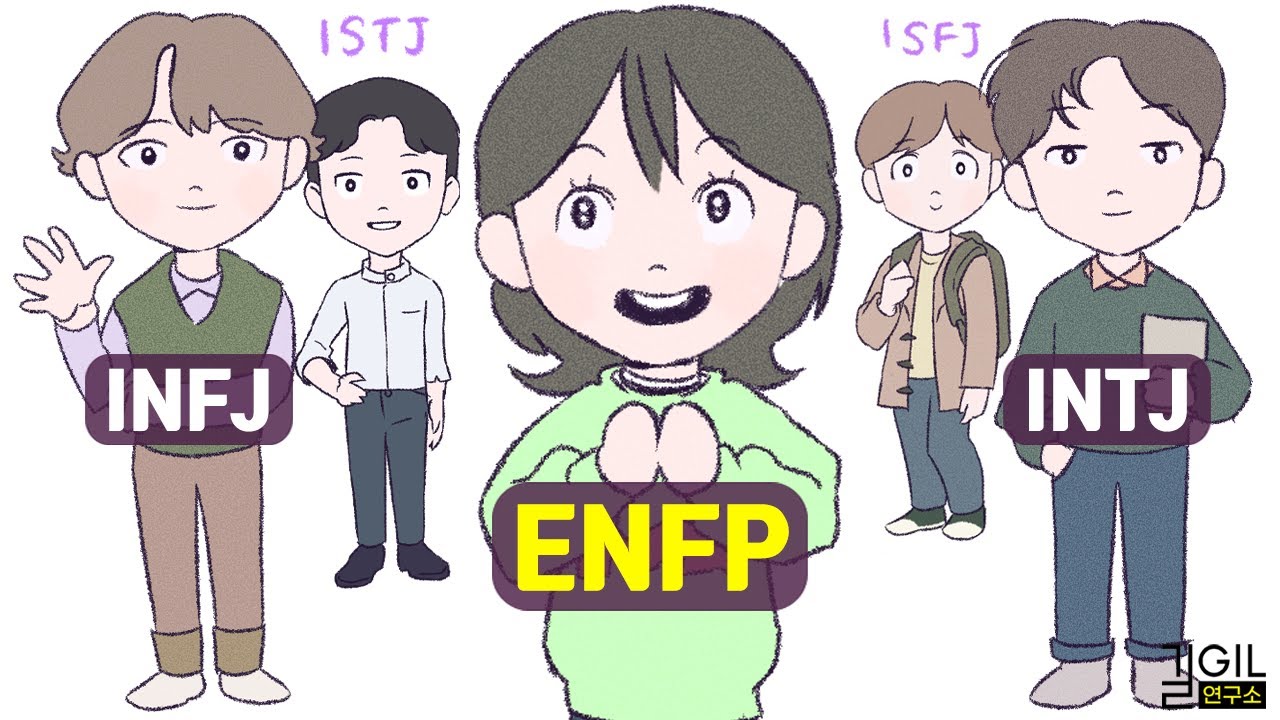
| ENFP | Frequently cited as an ideal match | Both share a strong values-driven mindset through their Ne/Ni and Fe/Fi dynamics, and the bright, warm energy of the ENFP helps the INFJ relax and open up. |
| ENTP | Highly complementary | The INFJ's vision and the ENTP's sharp logic and inventiveness challenge and inspire each other's growth. |
| INFJ | Deep mutual empathy, risk of stagnation | They understand each other intuitively, but because both tend to internalize their feelings, unaddressed tensions can quietly linger. |
| ISTP · ESTP | Initial distance | The fundamental contrast along the Intuitive (N) versus Sensing (S) axis makes it harder to find common conversational ground, requiring extra time to build mutual understanding. |
Keep in mind that these pairings reflect broad personality tendencies. No MBTI pairing guarantees success or failure on its own; real-world relationship health depends far more on mutual respect, care, and healthy communication.
Career & Paths
INFJs find the highest fulfillment in roles where "helping people" intersects with "creating purpose." Environments driven purely by raw numbers and quotas, or roles consisting of repetitive, mechanical tasks, tend to drain their energy and lead to rapid burnout.
- Counseling, Psychology & Education: Mental health counselor, school counselor, social worker — exceptionally skilled at listening deeply to personal narratives and offering profound insights.
- Writing & Creative Fields: Author, screenwriter, editor, copywriter — gifted at translating Ni insights and Fe empathy into resonant written words.
- Arts & Design: Illustrator, photographer, film or video director — naturally drawn to projects that convey nuanced messages through metaphor and visual symbolism.
- Non-Profit & Social Impact: NGOs, social enterprises, human rights or environmental organizations — highly engaged when working within organizations dedicated to realizing meaningful ideals.
On the other hand, frontline positions that demand rigid adherence to fixed rules or constant, real-time crisis management (such as handling high volumes of customer complaints or dealing with unpredictable on-the-spot emergencies) place heavy strain on their inferior function (Se) and frequently lead to severe fatigue. That said, these are general tendencies, and individual experience and adaptability create plenty of exceptions.
Notable INFJs
MBTI assessments are reliable only when verified through an official test or confirmed directly by the individuals themselves. Rather than listing speculative typings, here are well-known figures who have officially shared or confirmed their INFJ type:
- Author J.K. Rowling: The creator of the Harry Potter series confirmed her type in 2015 when she responded to a fan's inquiry on Twitter (now X) with, "I'm INFJ." She is one of the most frequently cited public examples of the type internationally.
- Actor Jo In-sung: On the tvN reality show Unexpected Business, he revealed that his official personality assessment identified him as an INFJ. His calm demeanor paired with inventive thinking and thoughtful care for those around him closely mirrors the INFJ's classic gentle-yet-resolute presence.
While many other public figures are rumored online to be INFJs, unverified guesses are omitted here to maintain accuracy.
INFJ vs. Other Types: Compatibility & Differences
INFJs are frequently confused with INFPs, INTJs, ENFJs, and ISFJs. If your results feel ambiguous, compare the types below, or explore the full spectrum of all 16 profiles on our MBTI guide. While they may differ by only a letter or two, their underlying cognitive functions operate quite differently.
| Type | Common Ground with INFJ | Key Difference |
|---|---|---|
| INFP | Shared idealism, introversion, intuitive and feeling preferences | INFJs lead with Fe (Extraverted Feeling), focusing first on the external atmosphere and group dynamics, whereas INFPs lead with Fi (Introverted Feeling), prioritizing deeply personal values and authenticity. INFJs instinctively start from "we," while INFPs start from "I." |
| INTJ | Shared dominant Ni (Introverted Intuition), strong long-range foresight | INFJs use auxiliary Fe, making decisions centered around people and relational harmony, whereas INTJs use auxiliary Te (Extraverted Thinking), prioritizing objective efficiency, logic, and measurable outcomes. |
| ENFJ | Shared preference for Feeling (Fe) and Intuition (N) | ENFJs lead with dominant Fe, actively guiding, organizing, and vocalizing support for groups, whereas INFJs lead with dominant Ni, preferring to synthesize insights internally before quietly exerting influence when necessary. |
| ISFJ | Shared Introverted (I) and Judging (J) preferences, deeply devoted nature | ISFJs rely on Si (Introverted Sensing), basing judgments on past precedent, concrete facts, and lived experience, whereas INFJs rely on Ni, basing decisions on hidden patterns, underlying themes, and future possibilities. |
Frequently Asked Questions
Q. Is the INFJ truly the rarest personality type in the world? A. In online survey data such as 16Personalities, INFJs frequently represent the lowest proportion of respondents—hovering around 1.5%—which is why they are widely recognized as the rarest type. However, online tests carry inherent sample biases based on who seeks them out, so precise figures vary depending on the testing organization and demographic sample.
Q. If INFJs are introverted, why are they often described as having strong leadership? A. Their style of leadership does not rely on commanding or micromanaging from the front. Instead, it is a quiet form of guidance: they cast a compelling vision through insight (Ni) and bring people together through genuine empathy (Fe). Rather than dominating a meeting, an INFJ often steps in at the pivotal moment to articulate the core issue that everyone else missed.
Q. Why do INFJs get depleted so easily in interpersonal relationships? A. They invest immense cognitive and emotional energy into reading and accommodating other people's feelings, often setting their own boundaries and frustrations aside. When this pattern goes unchecked over time, it leads directly to emotional exhaustion, sudden burnout, or a complete withdrawal from the relationship.
Q. Which types tend to struggle the most to connect with an INFJ? A. Concrete, spontaneous Sensing types—particularly ESTPs and ESFPs—often move through life at a very different conversational pace and wavelength. This difference in processing style can make early mutual understanding challenging, though it is a matter of natural orientation rather than an unavoidable incompatibility.
Q. Why do INFJs change career paths or struggle with career decisions so often? A. Because personal purpose is non-negotiable for this type. When stuck in routine administrative tasks or working within an organization whose mission they cannot ethically support, their motivation drops precipitously. As a result, INFJs tend to continually recalibrate their professional path until they find work that aligns with their core principles.